Fall 2026 · Université du Québec à Trois-Rivières · Department of Mathematics and Computer Science · taught in French
This course develops the theory of the Riemann integral and deepens the understanding of integral calculus and of series of functions: uniform continuity, the Riemann integral (fundamental theorem of calculus, improper integrals), sequences of functions, numerical series, series of functions and power series (Taylor series). It follows MPU1045 – Analysis in One Real Variable I, which is its prerequisite.
The course has four chapters:
the Riemann integral;
sequences of functions;
numerical series;
series of functions.
Applications4
Interactive applications to explore the notions of the course. They run in the browser, on a phone as well as on a computer, and can be projected in class.
Click a row to see the description and the link.
Application
Part of the course
Languages
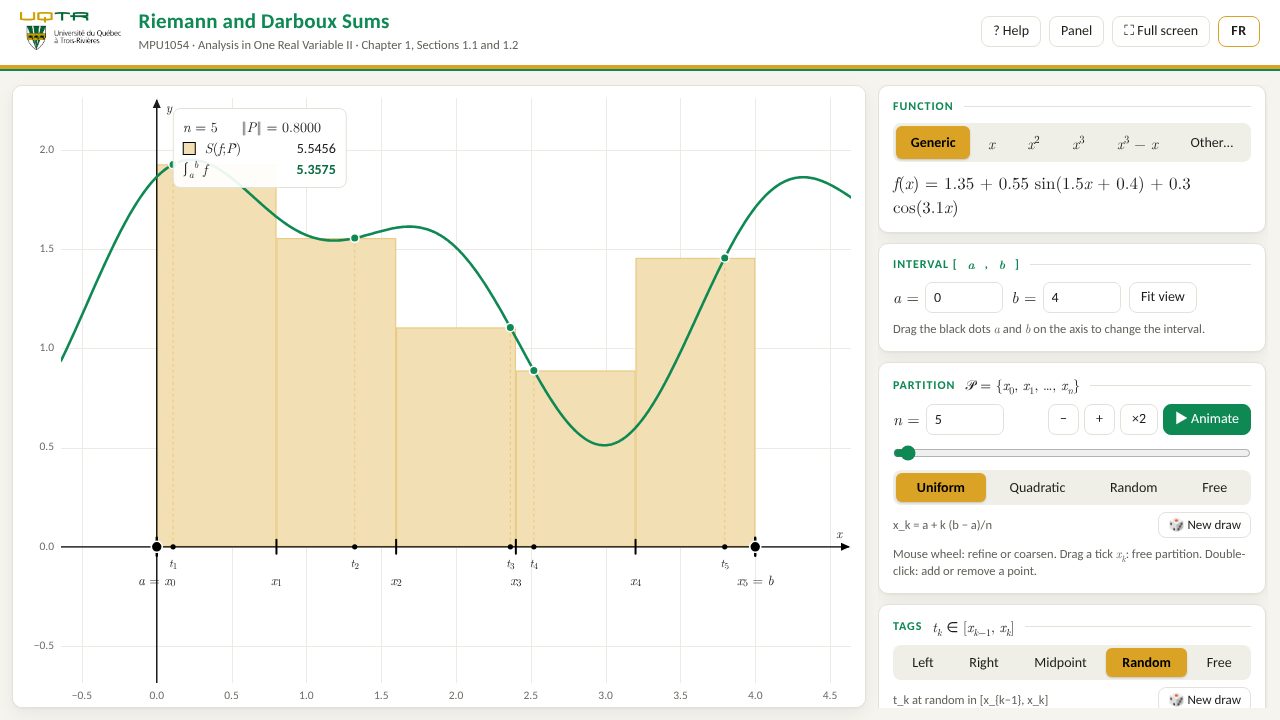
Riemann and Darboux sums
Chapter 1
EN, FR
Partitions, tags, Riemann sums, lower and upper Darboux sums, refinement and the limiting process.
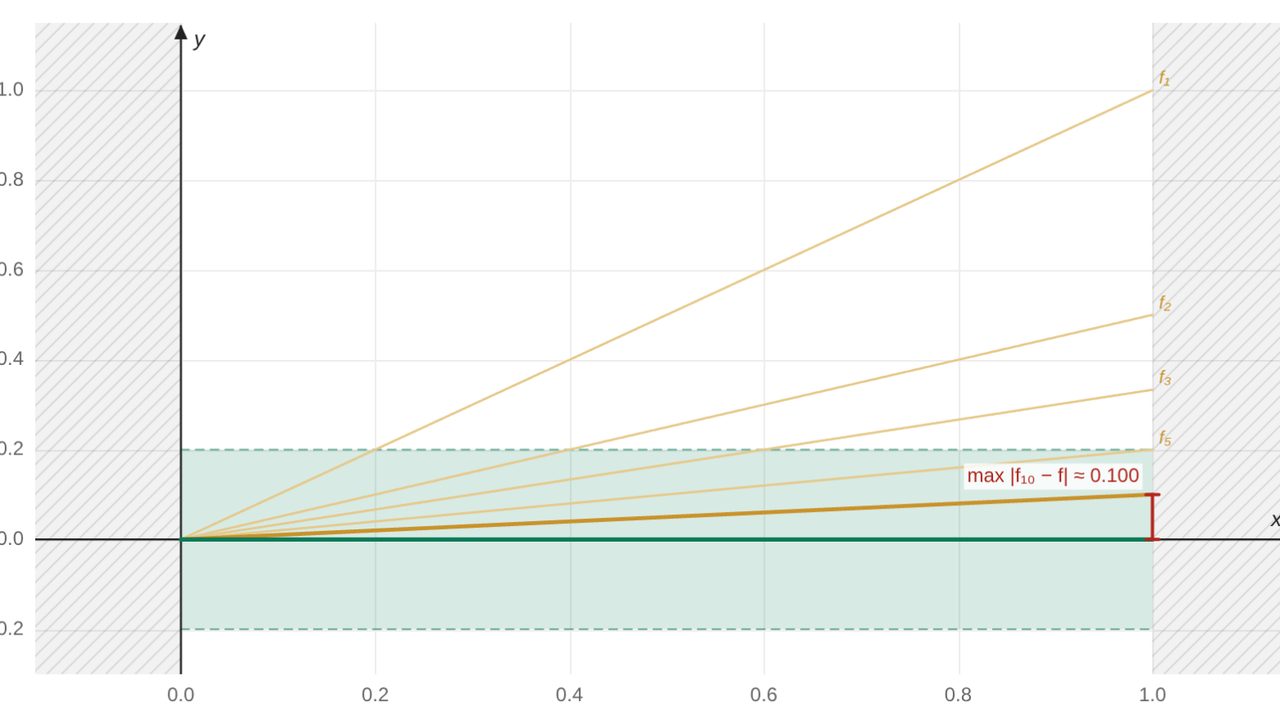
The pointwise limit, a few members of the sequence and the band of width \( 2\varepsilon \) around the limit, for the examples from the notes, the exercises of Section 2.1 or a sequence of your own: the convergence is uniform when, from some rank on, the graph of \( f_n \) lies entirely inside the band.
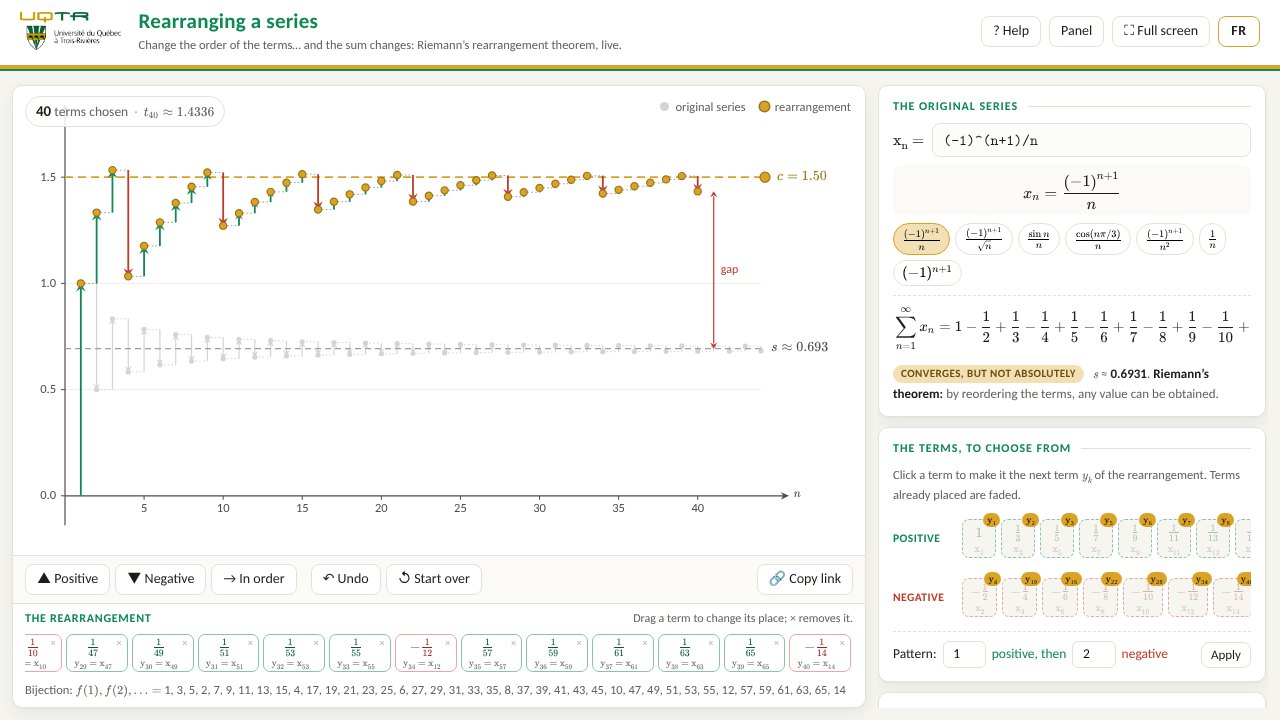
Riemann’s rearrangement theorem, live: for a series typed in, choose the terms \( y_k \) of the rearrangement yourself among the terms \( x_n \) of the series (from a bank of terms or right on the graph) and follow its partial sums next to those of the original series, or let Riemann’s procedure aim at a value \( c \) given in advance.
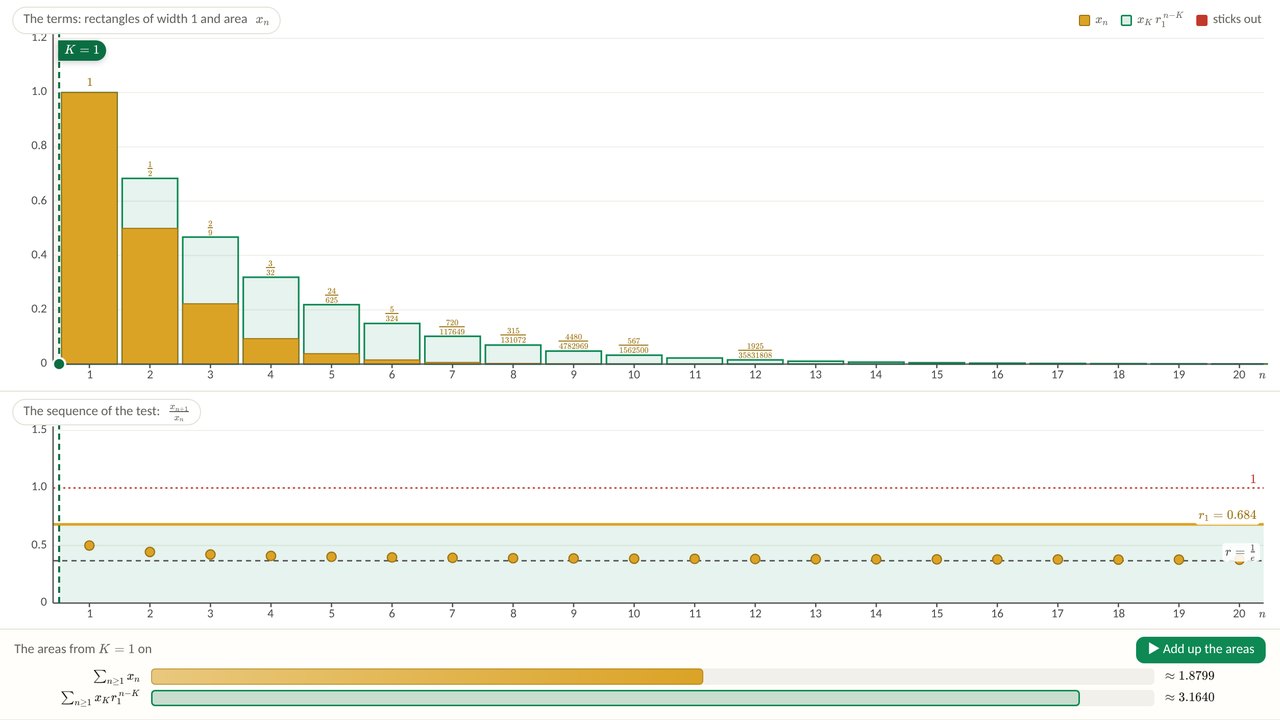
The comparison, limit comparison, root, ratio and integral tests seen as comparisons of areas: each term \( x_n \) is the area of a rectangle of width 1 and, from some rank \( N \) on, these rectangles stay below (or above) those of a series whose nature is known, or the curve \( y = f(t) \) of the integral test. Type in the general terms, move the rank, add up the areas and follow the reasoning of the test, step by step.
Proofs and examples from the course to complete by choosing, for each blank, the right option from a menu, or to reconstruct by putting their steps back in order, with immediate feedback and a printable version for the course notes, and two games to review the notions of the sections of your choice: flashcards and a team game. The activities are in French.
Click a row to see the description and the link.
Activity
Part of the course
Languages
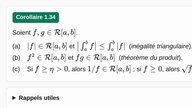
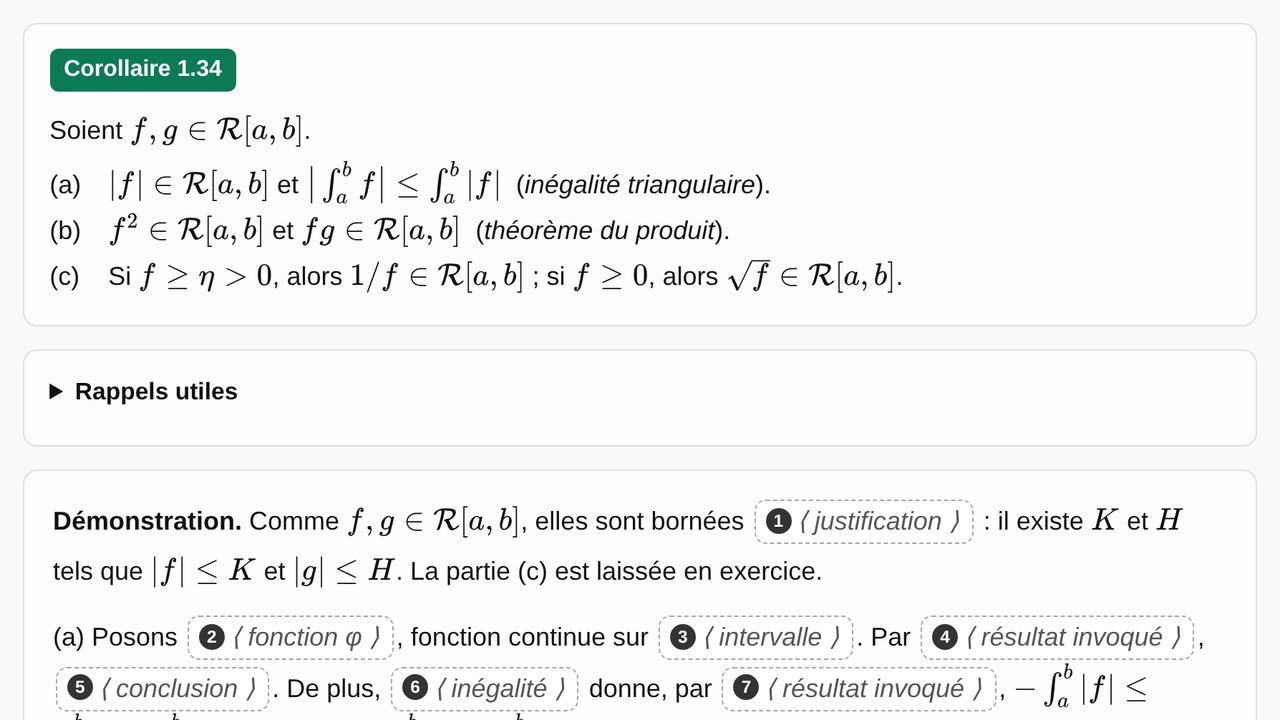
Fill-in-the-blanks proof – Corollary 1.34
Section 1.6
FR
The proof that \( |f| \), \( f^2 \) and \( fg \) are integrable.
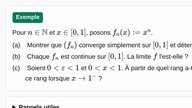
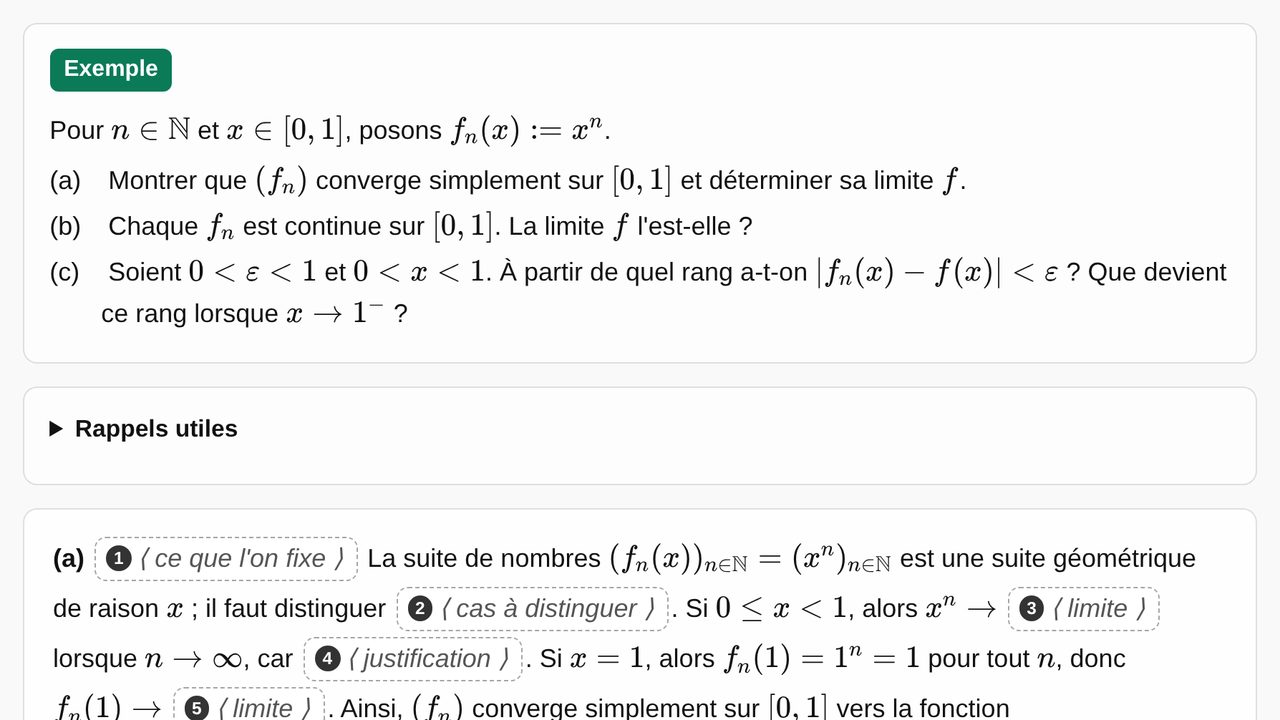
Fill-in-the-blanks example – the sequence \( x^n \) on \( [0, 1] \)
Section 2.1
FR
The pointwise limit case by case, the continuity of the limit and the rank \( N(\varepsilon, x) \), which depends on \( x \): pointwise convergence does not preserve continuity.
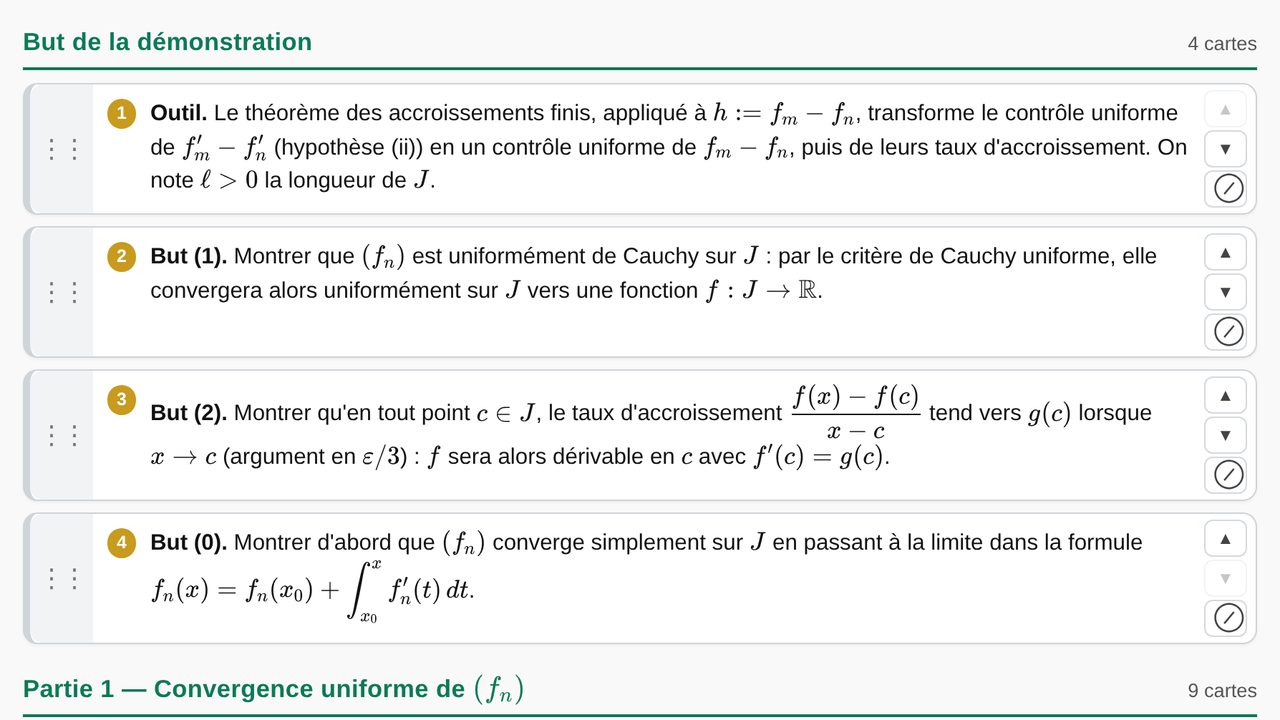
The proof that limit and derivative can be interchanged, split into three parts (the goal, the uniform convergence of \( (f_n) \), the differentiability of \( f \) with \( f' = g \)), whose steps are shown out of order, mixed with intruding steps to discard.
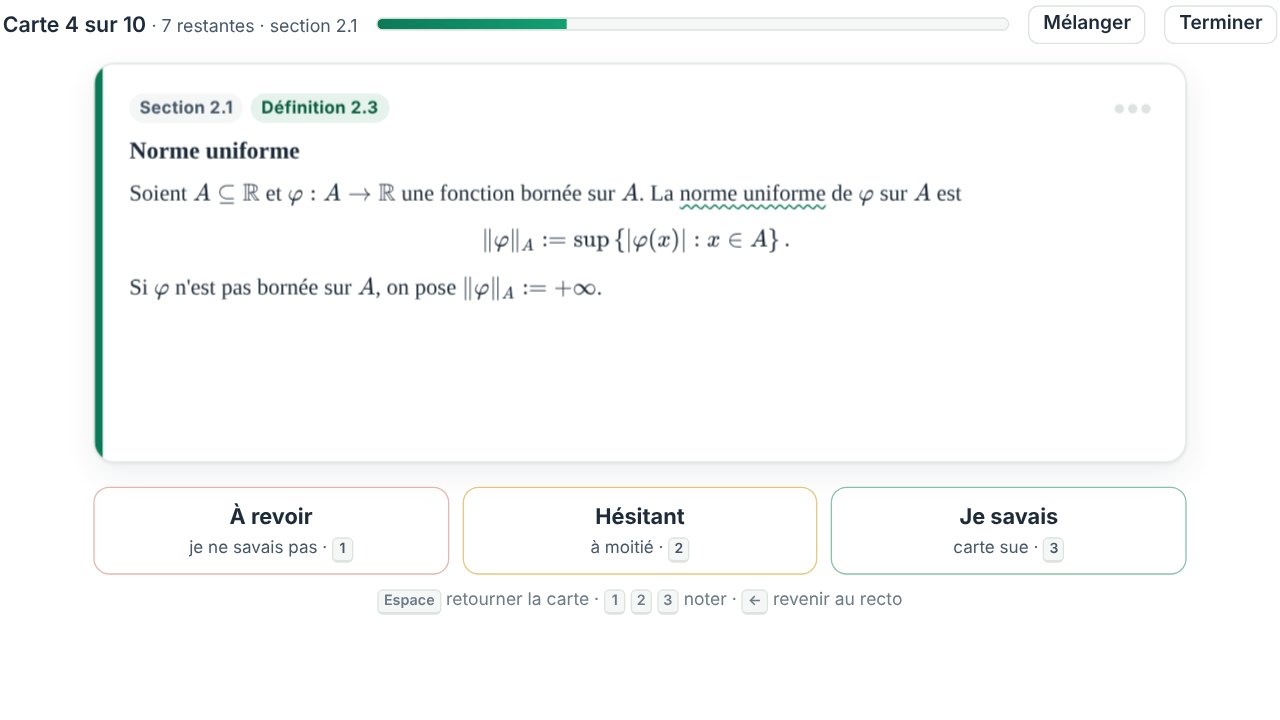
The definitions, theorems and examples of the course notes, for the sections of your choice (or the whole course): review them card by card, flipping each card and rating yourself, or take the timed challenge, where a statement has to be matched with its name among four.
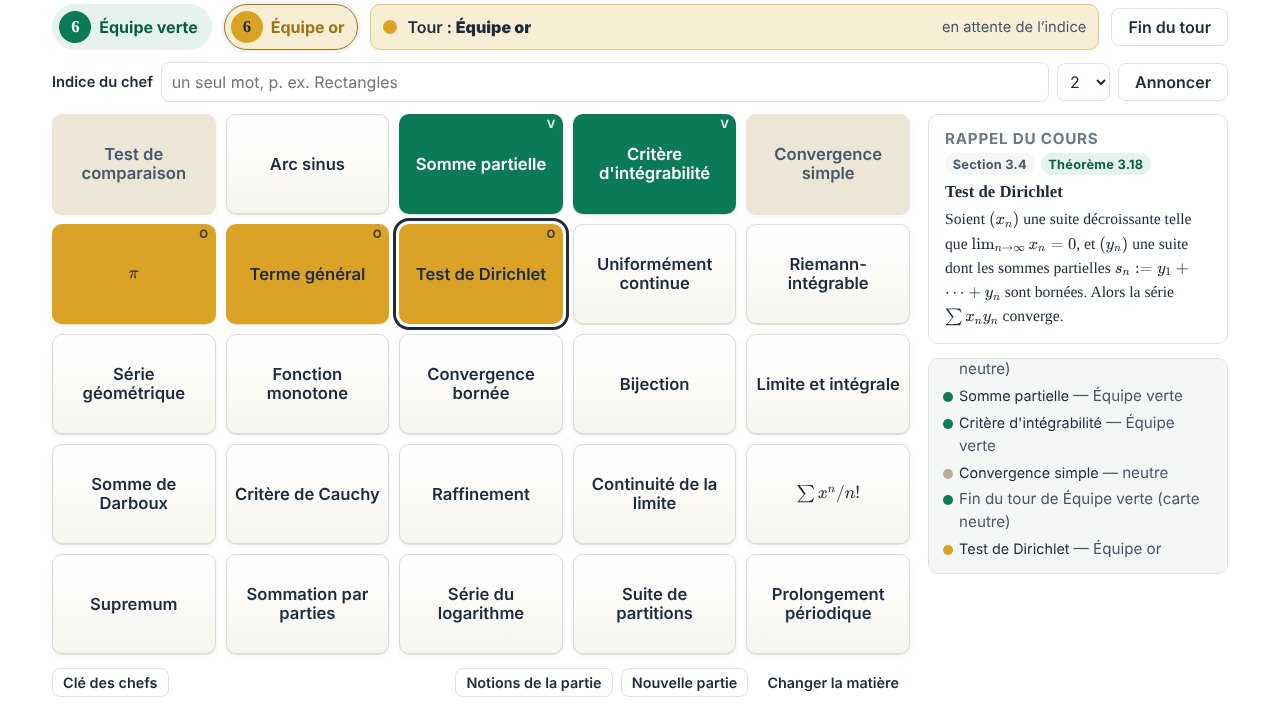
A team game for the classroom, inspired by Codenames: on a grid of notions from the chosen sections, each spymaster has the team guess its cards with a single word, while avoiding the counterexample. The spymasters see the key on their phones (QR code), and each revealed card shows the statement from the course notes.